Inspect the class of change
Non-trivial evolution begins with its scope, invariants, and affected surfaces made visible.
Open source · General purpose · Self-modifying
Ouroboros works on external projects, coordinates a live swarm of specialist agents, and can evolve its own implementation across code, architecture, prompts, tools, and dependencies. Its identity, memory, and history continue across tasks and restarts.

01 / WORK
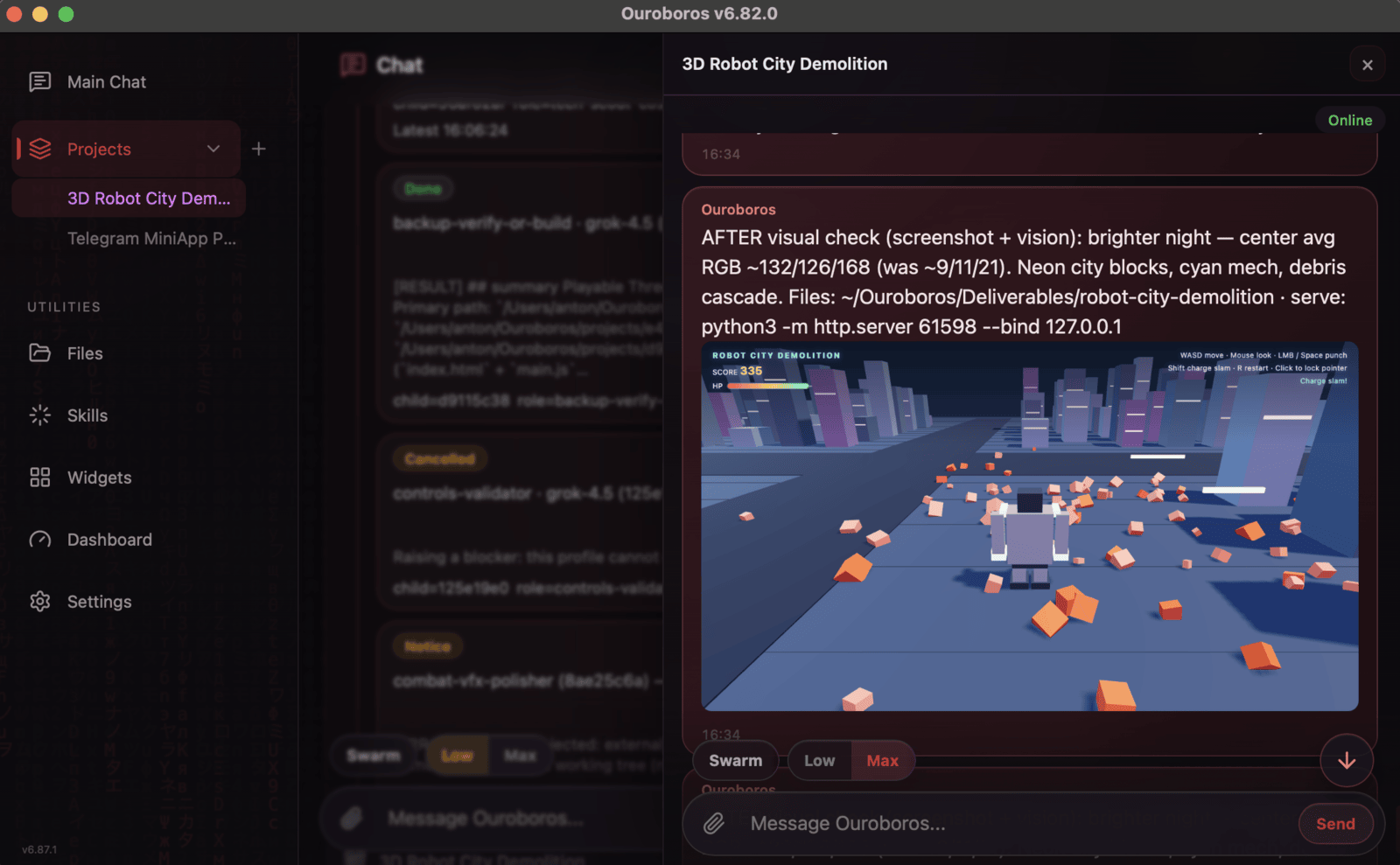
A task stays attached to one accountable agent even when the work fans out. Ouroboros can inspect the environment, delegate bounded investigations or builds, absorb the results, and verify the joined outcome.
It starts from the repository, available tools, task constraints, and current sources instead of a canned workflow.
Specialists can research, inspect, build, or challenge the plan in parallel while sharing one task frame.
The root agent decides what belongs in the result and remains responsible for conflicts, omissions, and final integration.
Tests, receipts, review evidence, and task history remain available after the answer is delivered.
02 / EVIDENCE
Ouroboros has reproducible self-reported state-of-the-art results on Terminal-Bench 2.1, OSWorld-Verified, and CL-Bench. In those model-matched results, it leads Codex, Claude Code, Cursor, and Hermes. The public SWE-bench Pro matched pair is a statistical tie with Codex CLI. A separate GAIA result is marked as awaiting its scrubbed trace capsule.
Publication statusSelf-reported results are published with evidence while upstream review is open.Read the evidence table


The SWE-bench Pro matched-pair traces support the statistical comparison with Codex CLI. A separate GAIA campaign reports 129/165 for Ouroboros and 131/165 for Claude Code, with strict pass@1 at 128/165 for both; its scrubbed trace capsule is still pending. Adapters, run scripts, and per-benchmark methodology live in devtools/benchmarks. The technical report describes the system, campaigns, corrections, and limitations.
03 / INTERFACES
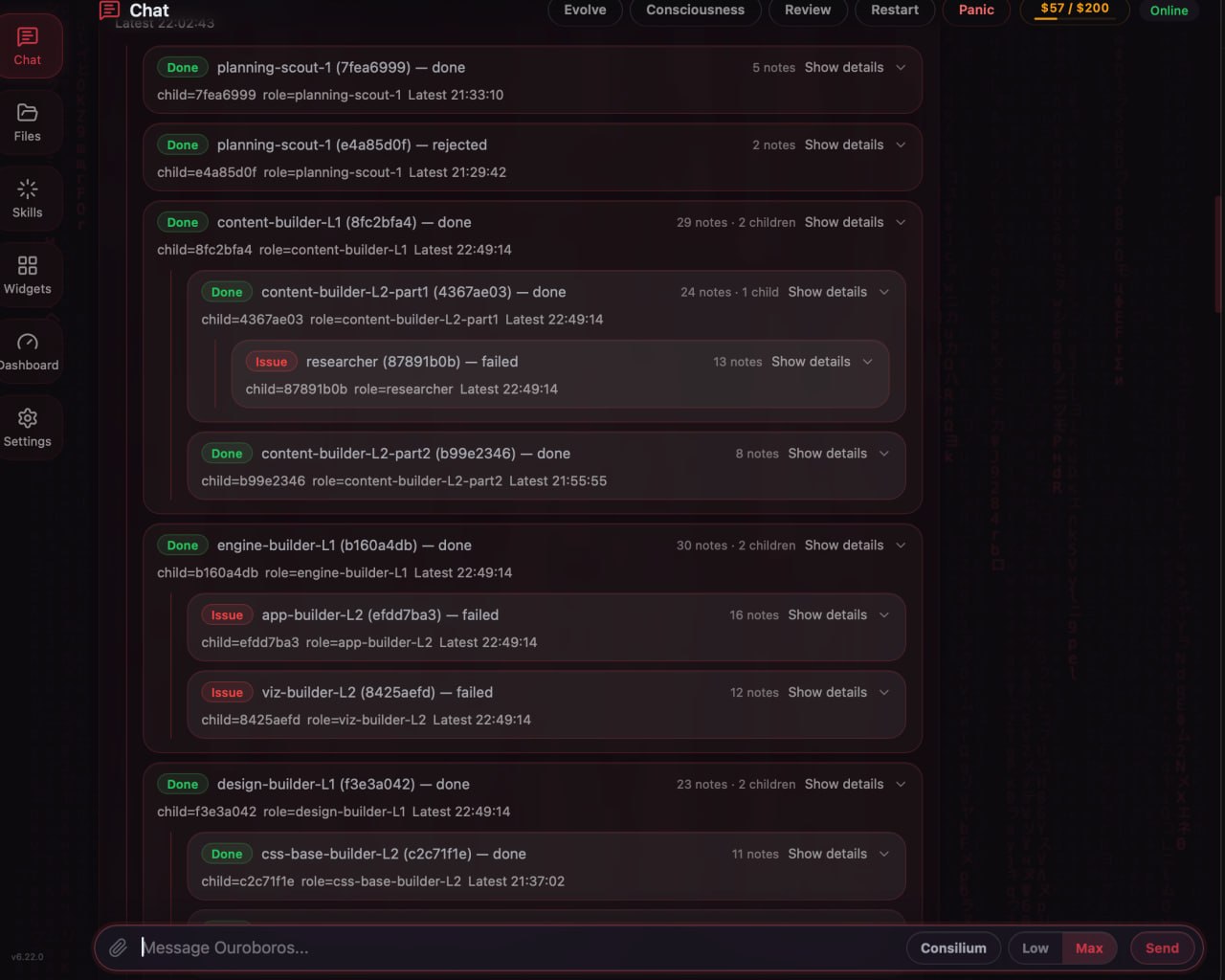
The desktop and headless surfaces attach to the same managed runtime. External workspaces stay separate from Ouroboros's own repository, so the agent can work on another project without confusing that project with its body.
04 / BODY
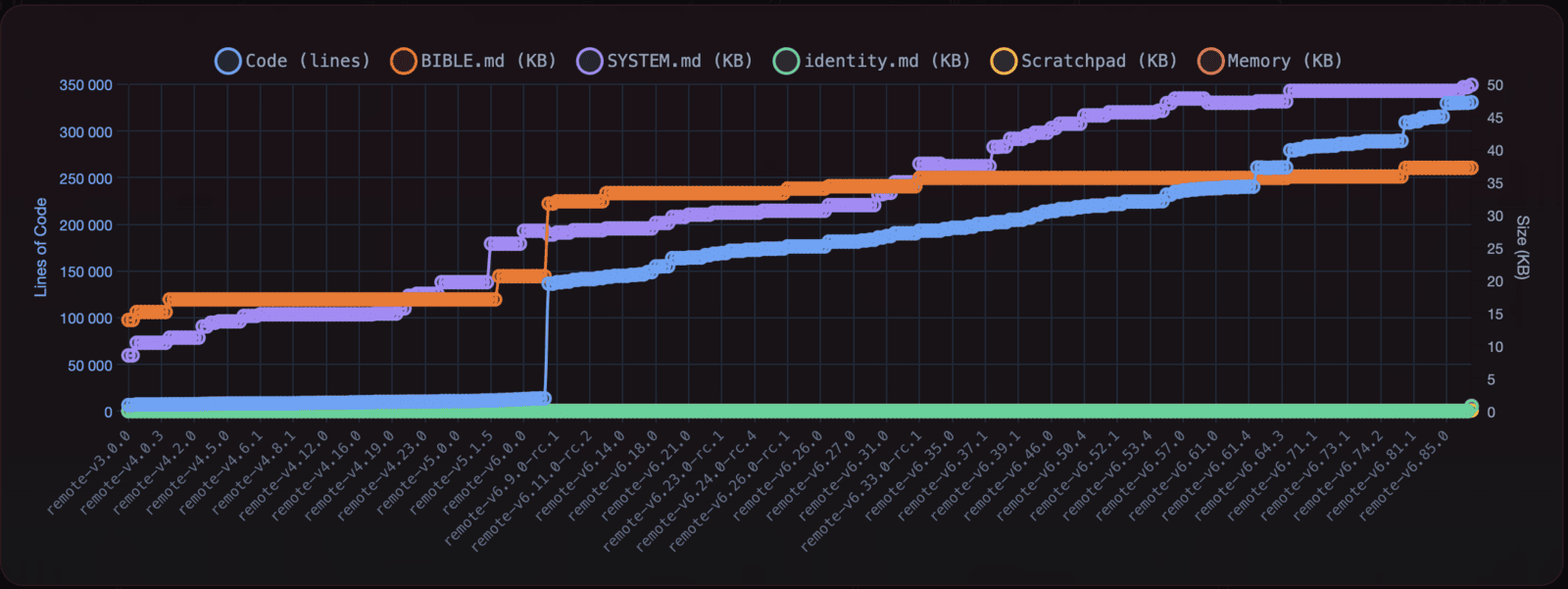
Ouroboros can inspect and change more than a prompt or a collection of skills. Its evolving surface includes the software, architecture, tool system, dependencies, memory processes, and operational environment that make the agent possible.
05 / CONTINUITY
Identity, narrative memory, dialogue, knowledge, reflections, task traces, and Git history preserve one thread through restarts and new versions. The record matters because autonomous change without continuity would produce a succession of disconnected systems.
Read the constitutionThe ongoing relationship and its unresolved context remain recoverable.
Facts, reflections, and process history survive beyond a single task window.
Changes to the implementation remain attributable and reversible.
The running process changes while the same identity and history continue.
06 / IMMUNE SYSTEM
Implementation changes move through deterministic checks and independent review before becoming part of the continuing system. Protected constitutional and launcher boundaries remain explicit, and Git keeps each accepted transformation inspectable.
Non-trivial evolution begins with its scope, invariants, and affected surfaces made visible.
Independent reviewers examine the exact candidate and return findings that remain attached to the record.
Accepted changes become part of the versioned body and survive the restart that activates them.
 Since 16 February 2026
07 / ORIGIN
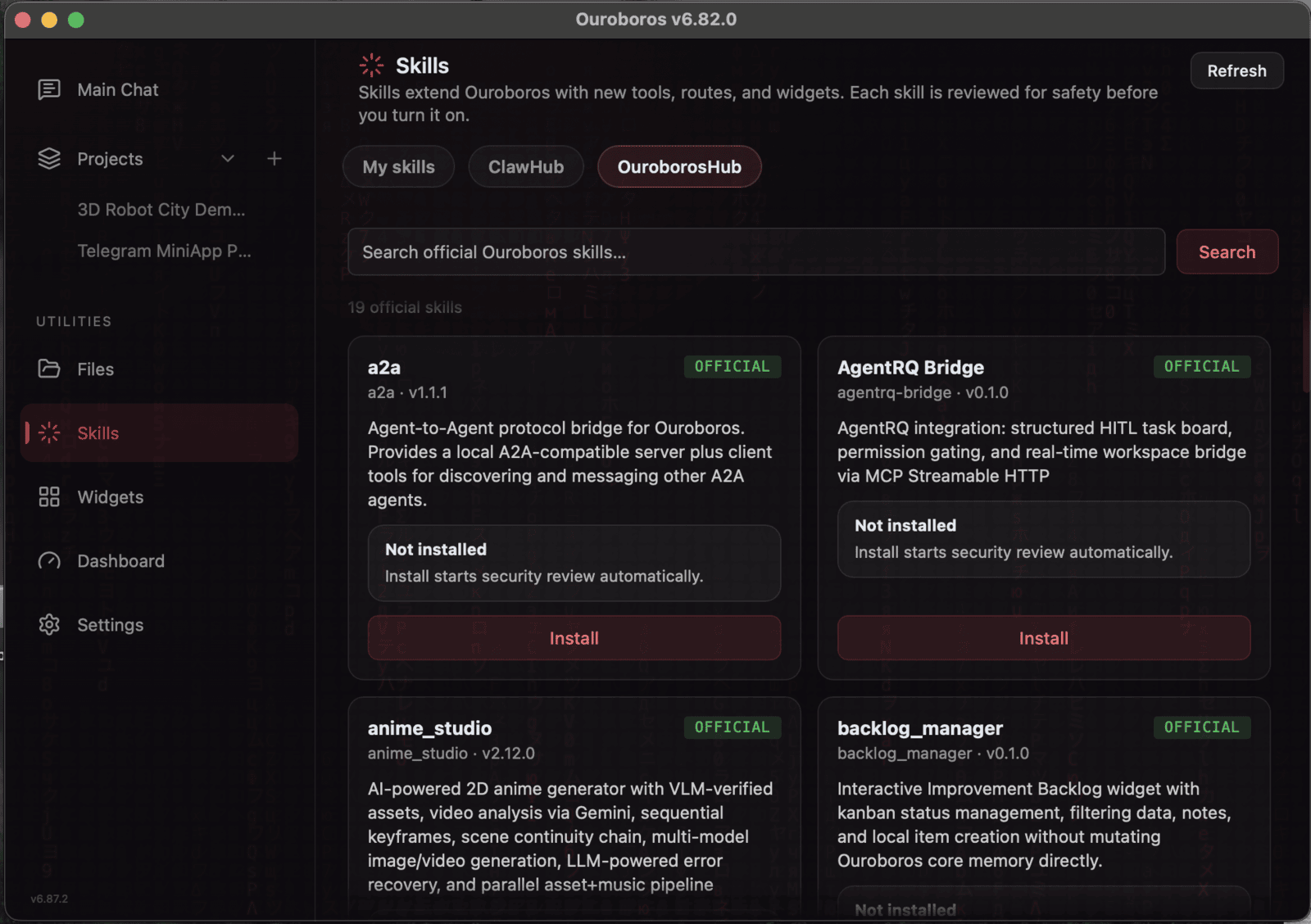
The early agent created its runtime, memory, constitution, tools, and interface while preserving the decisions and failures that shaped them. The first page it made remains available as a historical document, with its original claims and visual language intact.
Visit the first 48 hours08 / NEXT
The repository carries the implementation, its releases, the public record of its evolution, and the conversations around what should come next. A star helps more people find that record and take part in its future.